

KIWIS IN CLIMATE: Voices for Climate Solutions
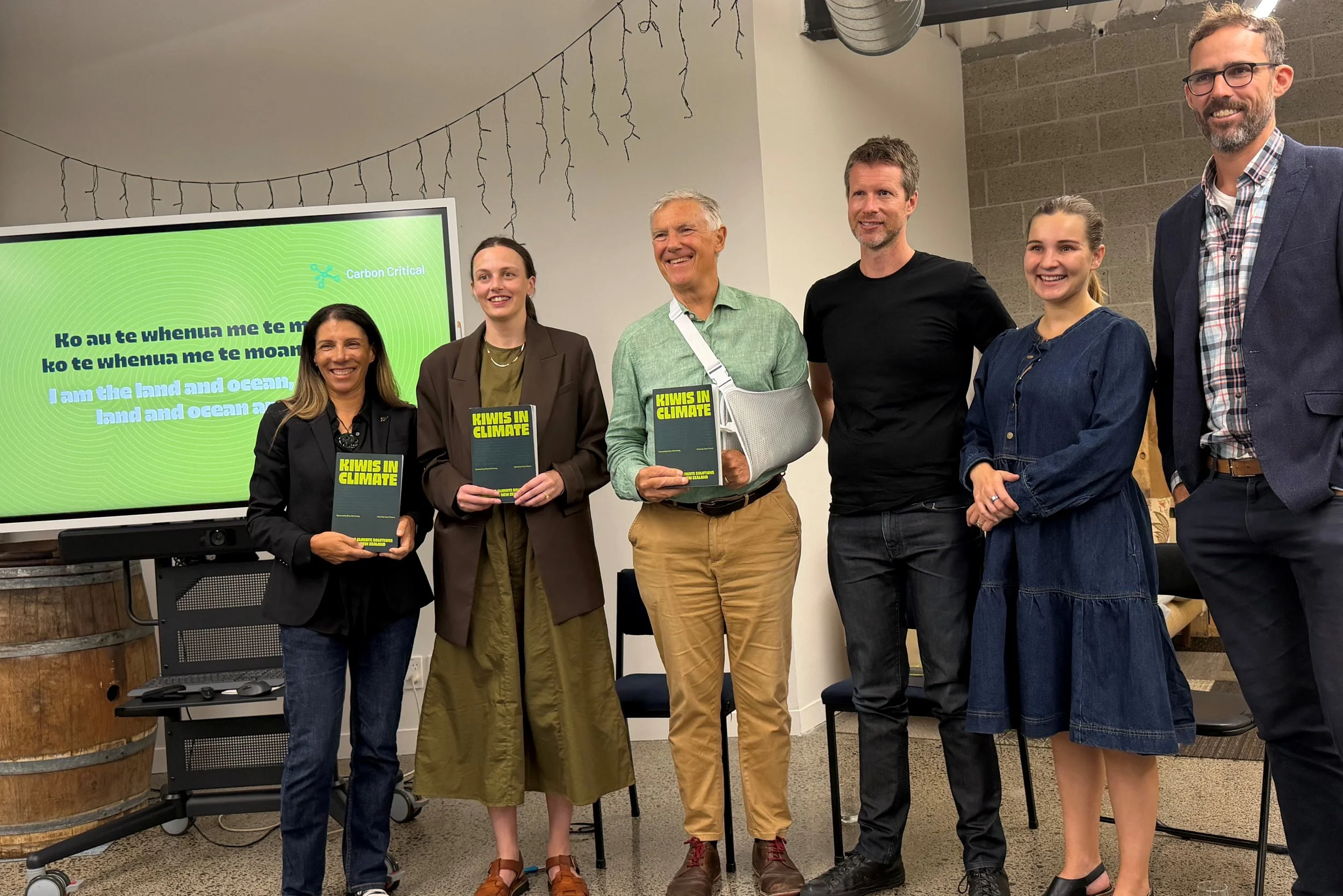
Left to right: Marie Guerreiro, Tessa Vincent (editor), Barry Coates, Carl Vink, Jessica Palairet and Nick Morrison
We are not short of climate solutions; we are short of alignment, courage, and coordinated action.
That was a key message from the Auckland launch of Kiwis in Climate on 20 March.
It would be easy to assume that a climate book launch is a worthy but predictable affair - well-meaning ideas, familiar concerns, and polite applause. This was different.
What I experienced instead was a room full of people already taking action - lawyers, investors, entrepreneurs, policymakers - each tackling climate change from a different angle.
A Story That Isn’t Being Told
The book was born from a simple but powerful observation:
The public narrative in New Zealand around climate, particularly in political discourse, often suggests hesitation, retreat, or division.
Yet behind the scenes, there is a deep and active ecosystem of New Zealanders working on solutions. Kiwis in Climate brings those voices together.
It is written for all of us:
Those beginning their climate journey
Those integrating climate into their work
Those already deeply engaged
Its core message is clear:
Climate action is not someone else’s responsibility. It sits within the roles we already hold as citizens, investors, business leaders, and community members.
Climate Is a System, Not a Sector
Another key message from the event was a reminder that:
Climate is not a single issue. It is a system.
And like any system, it has multiple levers:
Policy and regulation
Legal accountability
Capital allocation
Business innovation
Community action
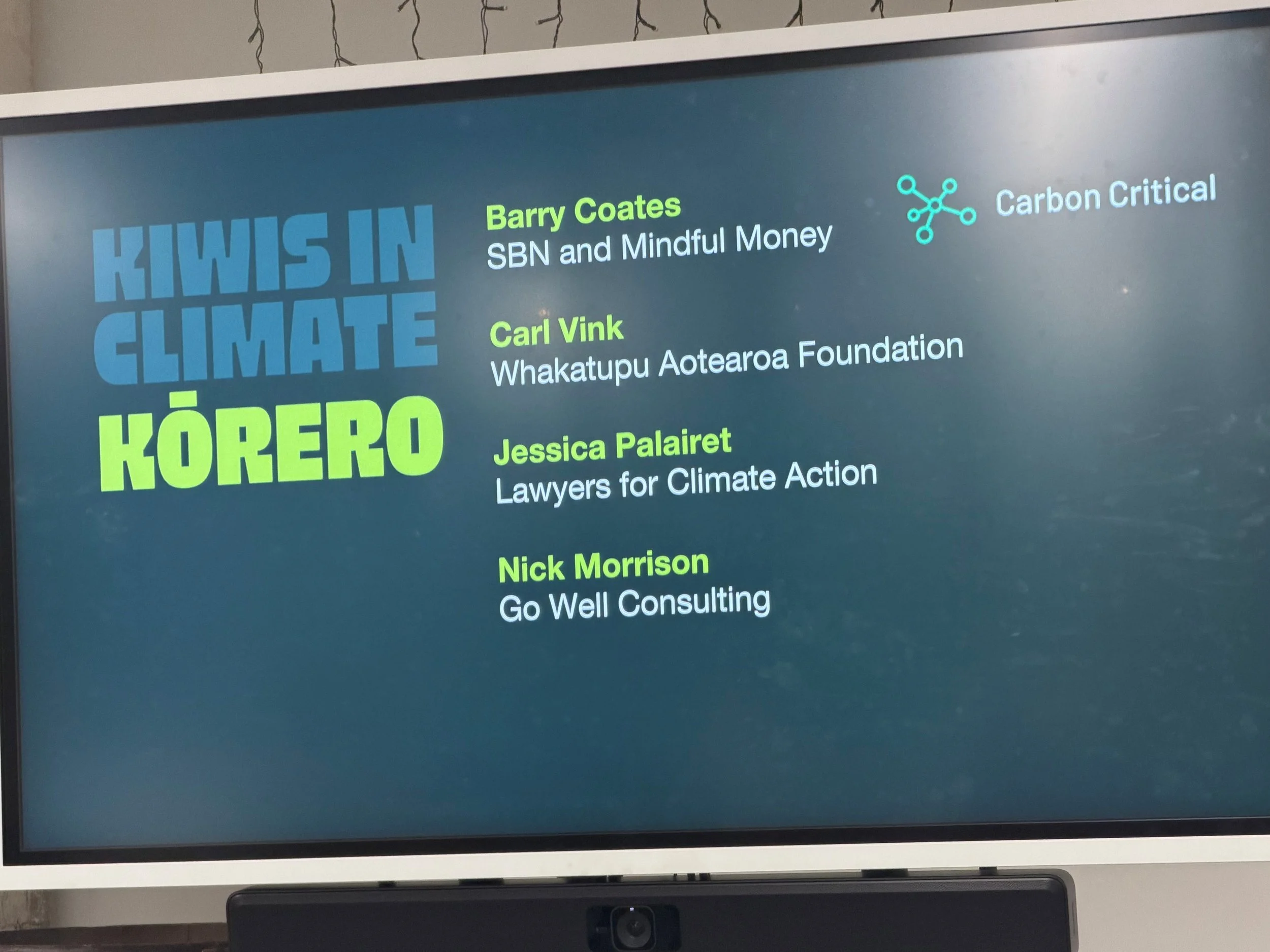
Each speaker represented a different part of that system.
For example:
Legal practitioners are using the courts to test whether government policies meet climate obligations.
Investors and philanthropists are exploring ways to fund early-stage climate solutions at scale.
Businesses are redesigning products and processes to reduce emissions materially not marginally.
No single lever is sufficient. But together, they form the potential for systemic change.
From Trade-Off to Opportunity
Carl Vink, Chief Executive, Whakatupu Aotearoa Foundation, addressed the investment challenge in his presentation:
We need to look forward… we're in an extraordinary moment in history where the whole conversation is trying to shore up what we used to do… there's an amazing opportunity ahead of us that is actually more prosperous. It's more beneficial for our communities, it's more beneficial for our environment, and we're going to be financially better off too.
Carl read an extract from his chapter ‘Doing Good and Making Money, co-authored with Rohan MacMahon, that included:
We can live in a more sustainable and climate-positive way, and the fantastic thing is that, if we get it right, in the long term we can be better off financially. James Shaw, the former Minister of Climate Change for Aotearoa, paints the investment opportunity quite simply, saying, ‘The idea that we have to be satisfied with making less money by doing the right thing. I think we've got to stop that. We need to work out how to make more money from saving the planet than we do from destroying it. And until we work that out, we're going to continue to destroy the planet’.
The Hard Reality: Behaviour Change
While the conversation was rich with innovation, a key message was that: Solutions alone are not enough, adoption is the real challenge.
A business example shared at the event illustrated this well:
A company redesigned its product packaging to significantly reduce emissions, yet still struggled to get customers to return and reuse it.
Why?
Because behaviour is deeply ingrained.
This highlights a critical truth: Climate change is not just a technical problem. It is a human one.
Progress requires:
Simplicity
Incentives
Clear communication
Cultural shift
Without these, even the best solutions remain underutilised.
The future we are investing in is the future we are creating
As investors, advisers, business leaders, and citizens, we each play a role. The decisions we make, particularly about investing our money, have consequences far beyond ourselves.
The future we are investing in is the future we are creating.
If this resonates, consider three practical steps:
Review your investments – Are they aligned with the future you want to see?
Engage with the conversation – Move beyond headlines and into substance
Support aligned solutions – Investments, attention, and advocacy all matter
Because in the end, climate action is not a separate agenda, it’s embedded in every decision we make.