

What Legacy Is Your Money Creating?
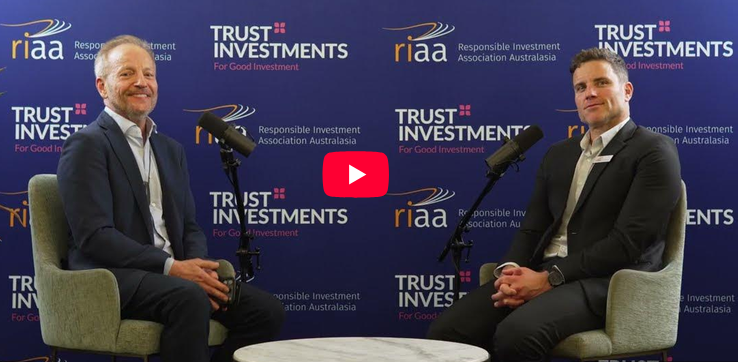
Dr Rodger Spiller (left) with RIAA Co-CEO Dean Hegarty, recording their Money Matters podcast conversation at the RIAA Conference Aotearoa NZ 2026 in Auckland. Watch or listen to the podcast with Dean Hegarty.
When Dean Hegarty explains what drew him to responsible investment, he begins with his children.
He imagined them one day asking: “When you realised we were going down this path, what did you do to try to fix it?”
He wanted to be able to give them a better answer.
That personal motivation opens our latest Money Matters podcast, recorded at the Responsible Investment Association Australasia’s Aotearoa New Zealand Conference 2026. It also connects closely with the theme of Ethical Investment Week: The Legacy We Leave.
For Dean, responsible investment offers a practical way to contribute. A healthy economy depends on a healthy society and an environment capable of supporting both. Investment decisions need to recognise those relationships.
During our conversation, Dean describes a shift in the industry’s discussions. Increasingly, the questions concern how responsible investment is being implemented, what is proving difficult and what needs to improve.
One important issue is investor engagement: how fund managers use their influence with companies to encourage change.
Dean is clear that engagement must come with accountability. Simply saying that a manager votes or talks to companies is insufficient. Investors need to understand what that activity is intended to achieve and how the manager is being held to account.
For people investing ethically, this raises a useful question: how do the investments we avoid, the activities we support and the influence exercised on our behalf work together?
Exclusions remain important for respecting an investor’s ethical boundaries. Engagement adds another dimension, particularly when problems extend across companies and industries. Our discussion explores why challenges such as artificial intelligence require this wider perspective.
We also examine RIAA certification and what investors can learn from it. Dean emphasises that investors have different values: understanding a fund’s approach remains essential when deciding whether it fits your own priorities.
The Sustainable Plus classification adds specific requirements around sustainability objectives in legal documentation, alignment of investment and ownership activities with those objectives, and tracking and reporting progress.
For investors, the conversation prompts some useful questions:
· How clearly do my investments reflect what matters to me?
· What are my fund managers seeking to change through their engagement?
· What evidence do they provide of progress?
· How well do I understand the sustainability claims made about my funds?
Dean also shares the priorities informing RIAA’s developing strategy, including its mission, standards and support for members putting responsible investment into practice.
The conversation returns us to the question that first motivated him: what will we be able to tell the next generation about the choices we made?
Watch or listen to “Ethical Investing: The Legacy We Leave” with Dean Hegarty on this page.
For a closer look at artificial intelligence and human rights, explore our accompanying Ethical Investing in the Age of AI blog and three podcast interviews and the Ethical Investment Guide to Artificial Intelligence and Human Rights.